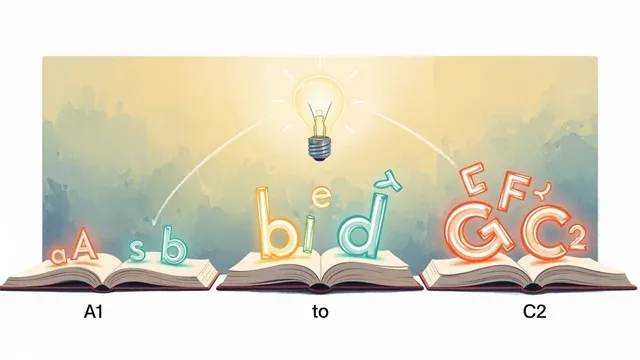
CEFR is a six-level scale that describes what you can do in a language, not what you know. It runs A1, A2, B1, B2, C1, C2 — from “I can order a coffee” to “I can argue a legal case.” It was built by the Council of Europe to give a French employer and a Brazilian university the same yardstick, and it has quietly become the standard label on almost every course, textbook, and exam in the world.
The codes look bureaucratic. The idea behind them is not. Every level is defined by a “can-do” statement — a concrete thing you can accomplish — which makes CEFR far more honest than “beginner / intermediate / advanced,” words that mean nothing without a reference point.
The three bands
The letters group into three bands. A is a basic user — you survive. B is an independent user — you live. C is a proficient user — you operate without thinking about the language at all.
Most learners spend the bulk of their time inside the B band, because that is the long climb from “I can get by” to “I barely notice I’m not in my first language.” A is faster than it looks. C is slower than people hope.
What each level actually means
A1 — you handle the basics, slowly. You can introduce yourself, ask and answer simple personal questions, and understand someone speaking very slowly and clearly when they’re being kind to you. Concretely: order food, buy a ticket, say where you’re from. A few weeks of focused input gets most people here for an easier language.
A2 — you manage routine situations. Shopping, directions, your daily schedule, simple past and future. You can have a basic exchange about familiar topics, as long as the other person is patient. This is the level where travel stops being stressful and starts being fun.
B1 — you become independent. You can follow the main points of clear speech on familiar topics, handle most situations that come up while traveling, and describe experiences, plans, and opinions with reasons. You make mistakes constantly and people understand you anyway. This is the threshold where the language becomes genuinely useful in your life rather than a practiced performance.
B2 — you operate with native speakers without strain. You can follow a normal conversation, watch a show without subtitles and get most of it, and argue a point with pros and cons. You still hit words you don’t know — you just route around them without stopping. When people say someone “speaks Spanish well,” they almost always mean B2.
C1 — you stop noticing the language. You read demanding texts, catch implicit meaning and tone, and speak fluently and spontaneously without visibly searching for words. You can use the language socially, academically, and professionally with flexibility. Most lifelong learners who use a language daily for years land here.
C2 — you have full command. You understand virtually everything you read or hear, summarize across sources, and express fine shades of meaning precisely. C2 is not “native” and not “perfect” — plenty of native speakers wouldn’t pass a C2 exam. It’s mastery of the language as a tool, not the absence of an accent.
Where most people actually land
Here’s the part the codes don’t tell you: B2 is the realistic destination for most serious learners, and it’s an excellent place to be. You can work, travel, watch films, read novels, and have real friendships in the language. The jump from B2 to C1 takes years of immersion, and C2 is a niche goal most people never need.
Time-to-level is also wildly uneven by language. For an English speaker, reaching B2 in Spanish is a fraction of the effort it takes in Mandarin — same scale, very different climb. So treat any “fluent in 3 months” claim as marketing. The scale is honest; the timelines people attach to it usually aren’t.
Why every SweetMango story has a level
Every story in SweetMango carries a CEFR badge — A1 through B1 today, more as the library grows. That label isn’t decoration. It’s how you find input at the right difficulty: roughly the level you’re at, or one notch above, where you understand most of it and figure out the rest from context.
Read a level where you catch 90 to 95 percent of the words and the climb takes care of itself. The badge is there so you don’t have to guess.